
Venetian plaster · Guide
What is Venetian plaster?
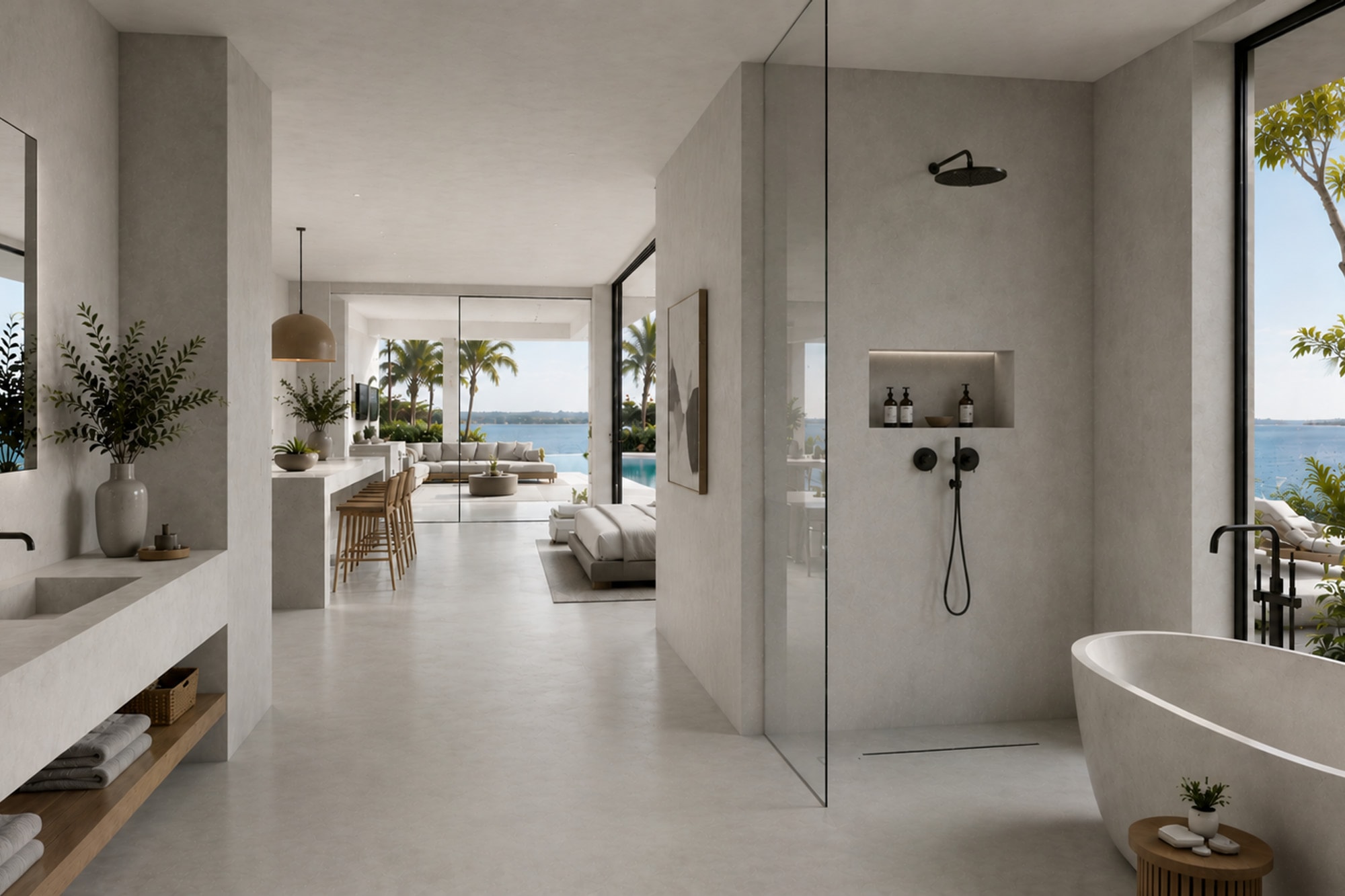
Lime, layered and burnished by hand.
Venetian plaster is a decorative wall finish made from lime putty and fine marble dust, applied by hand in thin, successive coats and then burnished — polished with a steel trowel — to a smooth, deep surface. Depending on how it's worked, it ranges from a soft matte marmorino to a high, almost glass-like sheen. It's one of the oldest wall finishes there is, and still one of the most beautiful.
How Venetian plaster is applied
Preparation
The wall is made smooth, sound and primed — Venetian plaster needs a good, even base to build on.
Base coats
Thin coats of tinted lime plaster are troweled on and left to set, building the color and the body of the finish.
Finish coat & movement
A final fine coat is laid on with deliberate trowel movement, creating the depth, veining and character of the surface.
Burnishing & sealing
The surface is burnished by hand to the chosen sheen, then — where the room needs it — sealed or waxed for protection.
Where Venetian plaster works
It's a wall and ceiling finish above all — used where a room wants depth, warmth and a sense of craft.
- Feature and accent walls
- Whole-room walls
- Ceilings and coves
- Entrance halls and stairwells
- Columns and curved surfaces
- Fireplaces and niches
- Bathrooms and damp areas, sealed appropriately
- Refined commercial and hospitality interiors
Why people choose it
- A luminous depth and movement no paint can match
- A hand-made, tactile, solid surface
- Breathable and lime-based — a natural finish
- Custom color, from soft to dramatic
- Timeless — it has been used for centuries
What to know before you commit
- It's a highly skilled, hand-applied finish — the applicator matters
- It needs a smooth, sound wall to build on
- High-polish finishes take more coats and more time
- It's a premium finish, priced for the craft
- In wet areas it must be sealed correctly
How it holds up
Venetian plaster is a hard, durable wall finish — the lime cures over time to a stone-like surface, and where a room needs extra protection it's sealed or waxed. It ages gracefully, developing a patina rather than peeling, and can be cleaned and re-waxed to refresh it. As with any hand-applied finish, the preparation of the wall and the skill of the application decide how well it wears — which is why we assess the surface before we quote.